
Why Making Friends With Shame Keeps You Stuck
Why Making Friends With Shame Keeps You Stuck
 emma.s.lyons@gmail.com
 Shame is not a teacher. It’s a prison

We have been fed the biggest lie there is: that a bit of shame is good for you. Keeps you “humble”. Keeps you “accountable”. Keeps you “good”. Lies. All of it. We’ve swallowed it whole. Shame makes you a shadow of who you realy are; half alive, dimmed, shrinking from life itself.
Shame isn’t a guide. Never was. It’s wiring in the nervous system that makes your mind collapse before you even move. Turns on yourself before you can thrive. The tight chest. The knot in your stomach. The little whisper telling you you’re too much, or not enough, or just wrong. It grabs your thoughts, your money, your relationships, your sense of self .
And until you dismantle it? nothing really changes.
Even therapy often leaves shame untouched. Sessions are structured: plan, homework, curriculum. Something urgent comes up? Struggling in the moment? We’re told, “Ah sure, we’ll look at that next week”. Insight? Tick-boxed. Click, job done. But your nervous system doesn’t work like that.
A lot of approaches focus on behaviour; monitor your actions, change habits, practice new responses. Sure, you might even “succeed.” But the wiring underneath? Still there. Loops running on autopilot. Self-attack, relational drama, money blocks- they keep running. Behavioural change alone? Illusion. Progress without freedom.
Even when you process memories, go to workshops and do self-help exercises – shame’s still looping under the surface. Engine running in the background. Hiding behind morality, self-awareness, “accountability”. We’re told to love it, integrate, to take it to therapy. Sure; polite ways to keep us in the cage.
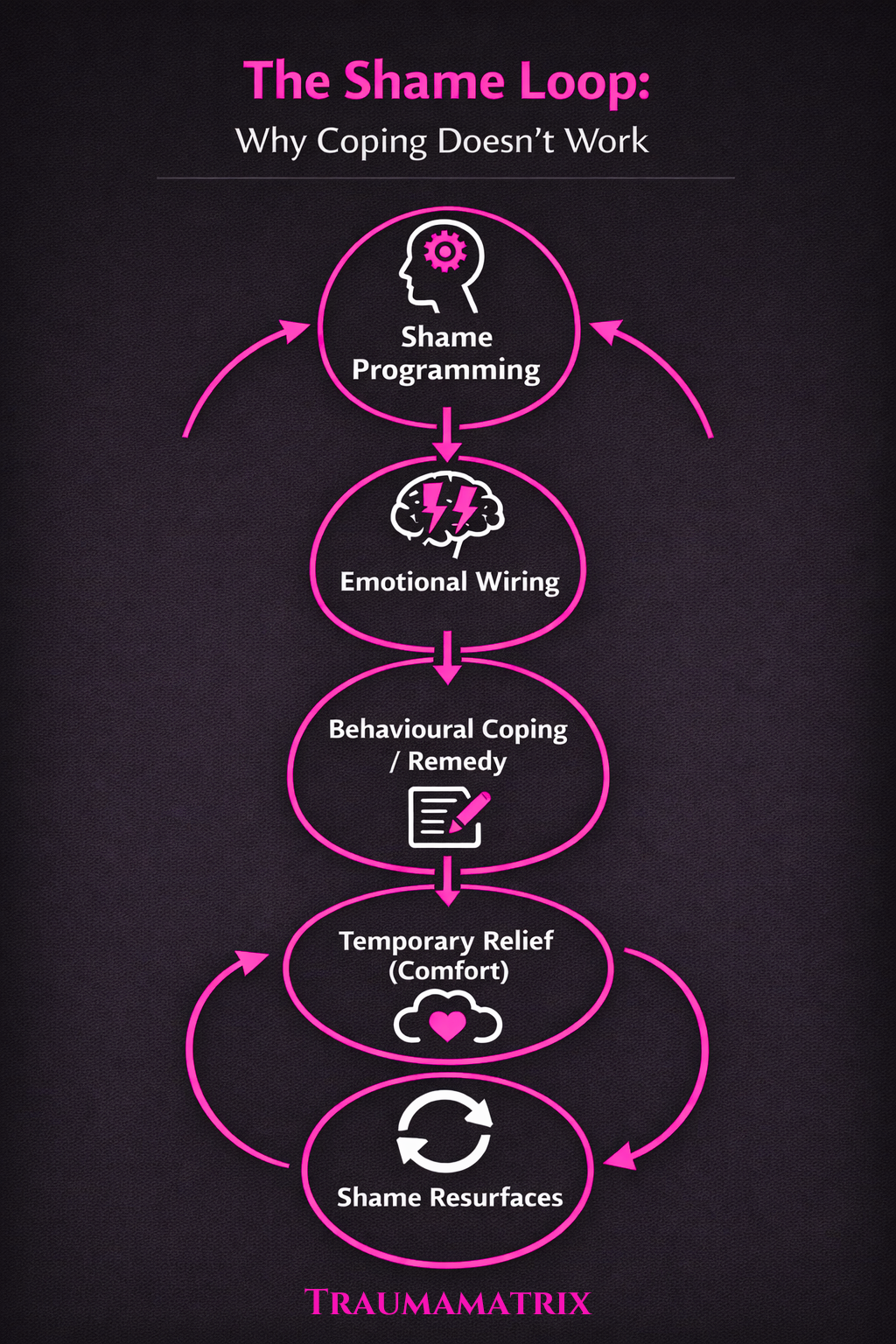
This isn’t about therapists being “bad”. Most are skilled, well-meaning. The problem isn’t them. It’s the system itself. Therapy is designed to be comfortable. It pacifies. Keeps people coming back, cycling through relief without release. Comfortable therapy keeps people safe, but it does not free them. Relief might last a minute, maybe even months, but the shame underneath (and the loops it drives) stays.
This is why so many people spend years, sometimes decades in therapy and are still not free. They catalogue every incident, write volumes about what is wrong and why. But if the shame, the true engine of the loops, remains the cycle carries on. Behavioural work alone? Incomplete. It treats symptoms, not cause.
Most approaches fail here. They teach coping. Make shame ‘more manageable’. Comfortably contained. While shame runs the show, people stay dependent, on therapy, on coping strategies, on guidance. Functional, yes. Free? Not at all.
I know because I lived it. Decades, a lifetime trapped in loops I couldn’t even name. Behaviour change, journaling, therapy, healing, yoga, I tried it all. Nothing touched the wiring. I built the Trauma Matrix because I needed a way out, for myself first. A way to truly start living. A way to step out of the grasp of shame.
When you dismantle shame itself, interrupt the loop at its source, you do more than change behaviour; you step fully into yourself. The nervous system learns a new way to respond. You’re no longer half alive. You’re fully here. Light, joy, presence, you remember what it feels like to be you, not the shadow shame carved out for you. People tell me it’s life-changing; old patterns of self-hatred, self-attack stop running automatically. Layers of subtle shame may still pop up, but the core grip is broken. True transformation becomes possible. Freedom isn’t just relief; it’s clarity, lightness, joy, and permission to be authentically you – often for the first time since you were a child.
And here’s the truth: There isn’t much in our current systems that offers you this freedom. Therapy, self-help, workshops; they offer coping, temporary relief, or new behaviours, but the underlying shame loops? Still there. That’s why I started looking for a way out. The first system I built for myself, to finally step out of the shame loops I’d been stuck repeating my whole life. I named the shame voice -the Inner Narcissist™ and developed the Break™ Methodology, a system to confront the shame programming at its source, dismantle it, and reclaim agency over the mind and nervous system. It worked for me, I started feeling a freedom and acceptance a sense of expansion and possibility I’d never experienced.
People tell me they get results just by engaging with the system itself, sometimes even without me being present. They suddenly stop giving away their power to shame. The results? Clarity, freedom, integration, and real movement out of patterns that held them hostage for years.
This work isn’t for everyone. It’s for the ones who’ve had enough; who refuse to remain prisoners of shame; who are ready to step fully into their own lives.
Reclaim Your Shameless, a six-week group programme, teaches the Trauma Matrix framework, shows how shame gets installed, and guides participants in breaking free from its grip.
For the deepest, most personal transformation, a three-month private container with weekly sessions is available. The group programme included, offering both personal work and the collective field.
This isn’t “comfortable” work. It is not about tolerance, management, or making friends with shame.
It is for the ones who refuse to live half-alive anymore, who are ready to dismantle shame from the inside out, stop hiding, and step into their most authentic, free version.
You can keep coping. Or you can step out of the cage. Choice is yours. Freedom is waiting. Are you ready to take it?
If you’re ready to take the first step, complete the application form. If you’re unsure which path fits, book a short conversation first
Copyright © Emma Lyons | Trauma Matrix All Rights Reserved.
Comments (12)
Trauma Matrix | Emma Lyons
Please note: Comments are for grounded reflection and questions related to the content. I don’t engage in personal emotional processing in comments or direct messages. If you want support with personal issues, please apply for my programs or reach out to work with me one-to-one.
Sol Luckman
This is golden.
George Cervenka
Thank you, I loved this!
Trauma Matrix | Emma Lyons
Thanks for your feedback George. If you liked this article, you might enjoy my last piece, about the systemic impact of shame on our society collectively. https://traumamatrix.substack.com/p/shame-is-the-operating-system
George Cervenka
Thank you so much, I will most certainly to that!
Sarah at Gentle Grove
Shame does run underneath everything – relationships, money, how we parent, how we shrink. And you’re right that most people never touch it directly.
I think about it differently though. Shame wasn’t random. It kept us small when being visible wasn’t safe. It was protection that outlived its usefulness. That doesn’t make it a friend – but it means it had a job.
The work for me isn’t making friends with it OR going to war with it. It’s understanding why my system chose it and then showing my body it doesn’t need it anymore. Slowly. Through the nervous system, not around it.
Trauma Matrix | Emma Lyons
Thanks for your comment, Sarah. I hear the framing of shame as protection. And yes, in unsafe systems it can function that way.
Where I fundamentally disagree is in treating shame as neutral or misunderstood.
Shame is manipulation, whether conscious or unconscious.
It collapses the self to preserve attachment. That is coercion, not care.
Shame is consistently framed as being “for” the person being shamed, when in reality it regulates and soothes the person or system doing the shaming. It operates as deflection, not accountability.
At scale, shame functions as a narcissistic regulator. It trains people to self-monitor, self-abandon, and self-silence so the system never has to change.
That is why our culture gives it so much power.
Mammalian bonding and attunement do not work through collapse. They work through contact.
Shame is napalm. It scorches aliveness so nothing grows back. Attunement is fire. It warms, signals, gathers, and transforms.
Yes, shame emerged where connection was not safe. But continuing to centre it as protector keeps us loyal to the very conditions that made it necessary.
Healing is not about understanding shame better. It is about restoring the conditions where shame is no longer needed at all.
Sarah at Gentle Grove
I think we’re closer than it sounds. I’m not centering shame as protector – I’m saying the body chose it for a reason, and understanding that reason is part of how you stop being loyal to it. Not to keep it. To release it. The path out matters as much as the destination
Trauma Matrix | Emma Lyons
Yes, the body did choose shame. And by that same logic, the development of narcissistic structures in individuals also had a function. They were protective adaptations to unsafe attachment.
That understanding doesn’t obligate us to centre them, negotiate with them, or pander to them. And critically, it doesn’t work.
Function explains origin. It does not justify continued power.
The same is true of shame. Knowing why it formed can inform the work, but it doesn’t mean we treat it as something to collaborate with on the way out.
The shame voice – the so-called inner critic – operates exactly like a narcissist. The only difference is that the call is coming from inside the house. Instead of manipulating others, it manipulates you, collapsing your self to preserve safety or attachment. Treating it as a wounded child to be soothed, or rebelling agains it, serve only to reinforce its authority.
Release comes from restoring contact and agency, not from extending empathy to mechanisms of control. Shame is napalm. It scorches aliveness so nothing grows back. Attunement is fire. It warms, signals, gathers, and transforms.
Yes, shame emerged where connection was not safe. But continuing to centre it as protector keeps us loyal to the very conditions that made it necessary. Healing isn’t about understanding shame better. It’s about restoring the conditions where shame is no longer needed at all.
Sarah at Gentle Grove
I think we’ve found the edges of where we see it differently and that’s okay. Appreciate the exchange.
Trauma Matrix | Emma Lyons
Absolutely. The conventional approach works for some, and that’s valid. My work is for those who’ve tried it for years without results and need a path that restores agency and rewires the nervous system.
Sarah at Gentle Grove
Somatics isn’t conventional. But I appreciate the exchange. All the best with your work.