
Scapegoats, Tyrants, and the Walking Dead: The Truth Behind Game of Thrones
Scapegoats, Tyrants, and the Walking Dead: The Truth Behind Game of Thrones
 Emma Lyons
 A mythic map of narcissistic systems – how golden children are created, truth-tellers exiled, and the rest turned to ghosts.
When Game of Thrones ended in 2019, the internet howled with disgust.
The “Breaker of Chains” torched a city. The supposed hero became a tyrant.
Audiences blamed the writers. And yes, the showrunners did rush the ending. But the betrayal we felt wasn’t just the result of bad storytelling, it was something deeper. It was the truth peeking through. Not just about Daenerys, but about the system itself. About how power actually works. About the narcissistic trauma loop we are all, to greater or lesser degrees, bound to.
In dysfunctional families, and in many institutions, people unconsciously fall into roles. It’s not just chaos; it’s a system. There’s the golden child, who is idealized but burdened with impossible expectations; the scapegoat, who gets blamed for everything; the invisible child, who’s ignored; and the enabler, who helps keep the dysfunction running smoothly. Daenerys’s story doesn’t just reflect these roles- it exposes their cost.
Daenerys is introduced in Season One as a beacon of hope. She is the Breaker of Chains. Not just a good leader, but the one who will shatter the entire system. With her silver-blonde glow, she fits the narcissistic ideal: the golden child. Within toxic family systems, the golden child can do no wrong. They are idealized, idolized, and burdened with the impossible task of saving the family’s image. Daenerys similarly assumes the role of golden child, and the system’s chosen sacrificial lamb. She frees slaves, liberates the Unsullied – but to do her “good work,” she shows no mercy. Again and again, she uses fire as judgment: burning her enemies alive, incinerating cities, flattening opposition. All in the name of freedom.
Sound familiar?
This is the classic narcissistic justification for violence. In narcissistic families, children are abused “for their own good.” Unquestioning obedience is demanded. Dissent is punished. Anyone who steps outside their assigned role is scapegoated — cast as the problem, and either coerced back into place or exiled entirely.
Daenerys’s transformation from golden child and liberator to tyrant isn’t a failure of character. It’s the only possible outcome within a narcissistic power structure. To survive, and to claim the throne, she must harden. Shut down empathy. Sacrifice her humanity. Every time she sets fire to her enemies, another piece of her soul burns with them.
The system requires it. It cannot run without it.
Her dragon fire symbolizes both purification and destruction, but also the exact violence narcissistic systems use to maintain control. Each act of burning becomes a ritual: a sacrifice of her own humanity to prove dominance. A confirmation of the system’s logic – power above all, no matter the cost.
Similarly, in a narcissistic system, the enabler isn’t just a side character, they are the scaffolding that holds the tyrant in place. Remove the enablers, and the system begins to crack. But as long as they stay, the wheel keeps turning. These people, often empathic, thoughtful and caring – become enablers as they protect the narcissist from the consequences of their actions. In so doing, they believe they’re holding the system together, while actually they ensure the continuation of the abuse.
The tragedy of the enabler is that they think they’re helping. But their refusal to challenge the system, their denial, their rationalization, actually keeps the narcissist intact. The enabler buys time for the tyrant to consolidate power. They talk themselves out of leaving, out of confronting, out of seeing.
In Game of Thrones, the enablers surrounding Daenerys – Tyrion, Jorah, Jon Snow, Missandei, and Grey Worm – believe in her vision. Or more accurately, they believe in the idea of her. Tyrion thinks he can advise her toward wisdom. Jorah believes love will redeem her. Jon believes loyalty will steer her back to sanity. Missandei and Grey Worm, both former slaves, tie their survival to her success. But like so many trauma-bonded bystanders, their loyalty, fear, and denial feed the cycle. They become apologists for her actions, paving the way for her inevitable descent into tyranny and madness.
Daenerys begins as the scapegoat – the unwanted daughter of a disgraced bloodline, cast out, married off, a pawn in a game she didn’t ask to play. But as she steps into the golden child role, she is anointed with the unbearable weight of redemption.
Just like the golden child in a dysfunctional family, she is projected onto by the collective’s hope. She becomes a symbol, not a person. Her own needs become irrelevant. To fulfil her role, she must lean into the same violence she once suffered. She must become the oppressor.
The golden child mask permits no weakness. Her real identity is taken hostage, her worth made conditional on performance, on loyalty, on fulfilling the family’s impossible obligation: take the throne, no matter the cost.
Her descent into vengeance and madness isn’t a personal failure. It’s structural inevitability. From scapegoat to queen. From victim to oppressor. From pawn to tyrant. Within the narcissistic system that governs Game of Thrones, and, by extension, our own, the wheel keeps turning. The names change. The roles rotate. But the logic remains the same.
Daenerys’s arc, from scapegoat to golden child to tyrant, is mirrored, but inverted, by Jon Snow. He begins as the invisible child: exiled, neglected, denied. Despite his royal bloodline, he is erased from the line of succession. Narcissistic systems disarm threats by refusing to see them. The invisible child often holds the truth, as in Jon’s case, but that truth is covered in shame and avoided at all costs.
To redeem himself, Jon takes the path of duty. He becomes the good soldier, channelling his suppressed identity into self-sacrifice and moral righteousness. The system rewards his silence, praises his usefulness, but never legitimizes him.
He joins with Daenerys because he sees himself in her, another scapegoat rejected by the system, and tries to save her in a way no one ever saved him. This trauma bond between them ensures that, despite his suspicions, he bends the knee and becomes her full-fledged enabler.
When her tyranny becomes undeniable, Jon steps into the truth-teller role. He does what no one else will: he kills her. He doesn’t do it out of hate, but from painful clarity. He sees what others refuse to – that she was always destined to become exactly what she claimed to oppose.
The dream of a messiah was a lie. He removes the figurehead, but refuses the throne. He refuses to lead. He doesn’t try to take over the system, he walks away from it.
This is a perfect parallel of narcissistic families, where the truth-teller is never crowned. That seat is reserved, usually for the golden child, who tells the most seductive lie.
In contrast to the golden-haired highborns of the Targaryens and Lannisters, dark-haired characters like Ned Stark, Robert Baratheon, and Jon Snow are tolerated as placeholders or regional leaders. They are allowed proximity to power, but are never legitimized by the system itself. As a result, when they are no longer useful, they are discarded.
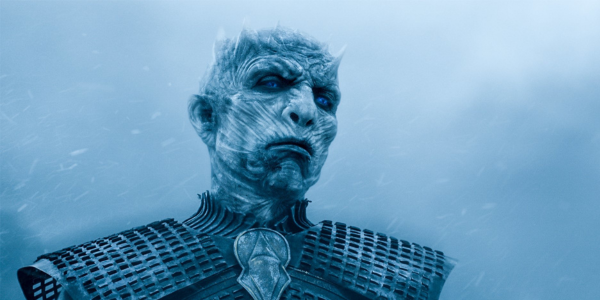
And then there is the Night King.
In a world that rewards image and punishes integrity, Daenerys becomes the tyrant and Jon reverts to exile. But the Night King is something else entirely. He is the shadow, the collective trauma of the system made manifest. Created by the Children of the Forest -symbolic of indigenous, pre-colonial civilizations – as a last-resort resistance to conquest and brutal colonization. He represents the karmic backlash of empire. He is the embodiment of numbness, disconnection, and savagery, the natural consequence of domination, colonization, and denial.
While presented as the villain, he is the symptom. And like all symptoms in narcissistic systems, he is scapegoated. Ignored. Forgotten. Left to fester and then feared when he returns.
The Night King’s army of the dead mirrors the world that created it. His followers are the emotionally flattened, spiritually erased casualties of empire – the walking dead. These are the ones who played their roles: soldier, servant, pawn. Not villains, but what’s left after the system strips a soul of will, identity, and inner life.
This doesn’t just happen in fantasy. It mirrors our world. Contemporary narcissistic systems demand self-abandonment. People numb themselves, suppress their truth, and adapt to survive. They become high-functioning ghosts, never asking what they want. Never knowing who they are. Until one day, maybe on their deathbed, they realize they never actually lived.
And yet, even the Night King is not defeated by the system. He is killed by Arya – the outsider. Arya is not the golden child. Not the scapegoat. Not the invisible one. She was never allowed into the system, and so she steps outside of it entirely. She becomes no one. She learns from death itself.
That’s why she, and she alone, can kill the Night King. Everyone else feeds him.
Arya is the healer. The shadow-walker. The one who sees what is real. And because she lives outside the system, she is not poisoned by its illusions of legacy, loyalty, or image.
She slays the symptom. But even she cannot touch the root of the entrenched narcissistic system.
Just like Jon, Arya removes the threat – and remains unwanted. She does the impossible, saves the world, and is still denied a seat at the table. The Night King and his army are vanquished – for now. But as the fundamental root cause remains unaddressed, it is only a matter of time before the Night King – or something even more ominous – emerges from the other side of the wall.
Game of Thrones struck a nerve, not because it is fantasy, but because it is a mythical mirror of our own world. It shows us the machinery of power: how golden children are worshipped until they burn everything down, how truth-tellers are exiled, and how the walking wounded scapegoats are discarded and abused.
It maps the roles we play, in our families, at work, in politics, and how easily we betray ourselves just to survive.
The betrayal we felt at the end wasn’t just about Daenerys.
It was the same betrayal we’ve all lived: waiting for the system to save us, only to discover that it was the same system that broke us.
If we want a different ending, not just in fiction, but in life, we can’t crown another hero and hope for the best.
We have to do the soul-wrenching work of breaking the wheel – not with fire, but with truth.
We have to burn the scripts that bound us, and dare to write a new story of who we really are – not the ghost who performs to survive, but the one who feels, who remembers, who reclaims.
A life where feeling is not dangerous.
Where aliveness isn’t punished.
Where you are no longer exiled from yourself.
editor’s note
This essay is the result of months unpacking the patterns behind a story millions thought was just fantasy. It’s about family, power, and trauma playing out on an epic scale — because these roles aren’t just in Westeros, they’re in our lives.
I’m sharing this because these truths need naming. If it resonates, please subscribe to catch the next parts, where I dive deeper into the family roles and the shadow systems behind them.
If you want to support this kind of honest, unfiltered work, please subscribe, and consider becoming a paid subscriber to ensure the continuity of this work.
Another way to support this work is to buy me a coffee over on paypal👉 https://paypal.me/traumamatrix
Thanks for reading — and for refusing to look away.